Tuesday, March 5, 7:30 PM, online
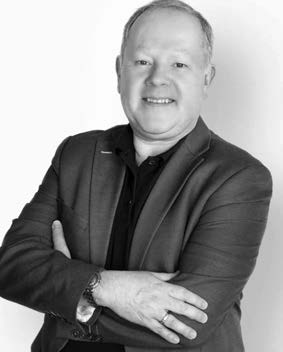
Dr. Gustavo Duque
The Risk of Falls in Seniors and How to Prevent Them
In this session, we will discuss the importance of identifying risk factors for falls in older persons and current strategies to prevent those events in this population.
PROFESSOR GUSTAVO DUQUE, MD, Ph.D., FRACP, is a geriatrician and biomedical scientist with a research interest in the mechanisms, potential therapies and biomarkers for age-related bone loss, osteoporosis, sarcopenia, osteosarcopenia and frailty in older persons. He is also looking at the effect of vitamin D, exercise and proteins on bone and muscle mass.
His initial training included Internal Medicine at Javeriana University (Colombia) and Geriatric Medicine. In 2003 he obtained his Ph.D. at McGill University with a thesis entitled “Molecular Changes of the Aging Osteoblast”. In 2007 he moved to Australia and became Head of the Division of Geriatric Medicine and Director of the Musculoskeletal Ageing Research Program at University of Sydney, where in 2012 he was promoted to Professor of Medicine. In 2015-2022 Prof. Duque held the positions of Chair of Medicine and Director of the Australian Institute for Musculoskeletal Science at the University of Melbourne.
In 2022 Prof. Duque assumed the roles of Full Professor at Dr. Joseph Kaufmann Chair in Geriatric Medicine, Director at RUISSS McGill Centre of Excellence for Sustainable Health of Seniors / Simone & Edouard Shouela (CEDurable) and Principal Investigator at the Bone, Muscle & Geroscience Group of the Research Institute of the McGill University Health Centre (MUHC). He is also the Editor-in-Chief of the Journal of Gerontology: Biological Sciences, one of the official journals of the Gerontological Society of America.
As a geriatrician and clinician-investigator, Prof. Duque has implemented several Falls and Fractures clinics (the most recent at the MUHC). His clinical trials unit conducts testing the effect of pharmacological and non-pharmacological treatments for agerelated musculoskeletal diseases. He is the author of more than 280 peer-reviewed articles and multiple book chapters and has edited five books in the aging and musculoskeletal fields.
Tuesday, March 19, 7:30 PM, online
Gwendolyn Owens
Public Art in the 21st Century: Challenges and Priorities

Sculptures removed under cover of darkness, statues knocked over, graffiti covering faces and inscriptions—it can seem as if public art is a target
everywhere. What is not in the news is how much public art is appreciated and indeed loved by people who see it everyday.
This talk will put this situation in historical context. Public art goes back to the beginning of history as the paintings in caves were early public art—think of Greek statues, the Sphinx in Egypt! The challenge of determining what should be public art (who gets to be honoured, what type of art, etc.) and how we should protect it is nothing new. What can we learn from this history to help us think about the situation today?
GWENDOLYN OWENS is the Director of the Visual Arts Collection at McGill University in Montreal, Quebec.
This growing collection includes over 3500 works of art on view in 90 buildings and on the grounds of the University’s three campuses.
She was previously the Assistant Director, Curatorial Affairs, at the Canadian Centre for Architecture and Consulting Curator responsible for the Gordon Matta-Clark Archive at the institution.
Her scholarly publications include articles, exhibition catalogues and books on a wide range of topics including artist-architect Gordon Matta-Clark, on whom she has written extensively; mid-nineteenth century American landscape painting; painters Maurice Prendergast and David Milne; artist and architect Melvin Charney; art markets in the 20th century; and kitchen wallpaper.
With Philip Ursprung, she co-edited Gordon Matta-Clark: An Archival Sourcebook (University of California Press, 2022).
She is currently researching the art of Montreal artist Marian Dale Scott (1906-1993).
The McGill University Department of Family Medicine and
the St. James Literary Society are pleased to present
THE DR. HIRSH ROSENFELD ANNUAL DISTINGUISHED LECTURE IN FAMILY MEDICINE
Tuesday, May 7, 7:00 PM
Department of Family Medicine
5858 Côte-des-Neiges (3rd floor) or online
Dr. Mark Ware
The Challenge of Pain: Art, Science and Beyond
Free admission
Open for the general public
Space is limited
Reservations are required
The importance of learning how to improve pain care comes directly from the need for better understanding and management of chronic pain. One in five adult Canadians lives with chronic pain. This comes with a huge cost to society, both directly and indirectly causing loss of work and disruptions to the patient’s social structures and quality of life.
The Alan Edwards Pain Management Unit is one of the oldest pain clinics in Canada. Over several decades, the clinic has grown to be a truly multidisciplinary team including physicians, psychologists, physical therapists and other allied health professionals.
Of interest to the general public as well as to health-care professionals, this Distinguished Lecture Series in Family Medicine was inaugurated in 1990 and was made possible by an endowment by the late Dr. Hirsh Rosenfeld, a Montreal family physician. He was a staunch supporter of a number of educational activities and this lecture series is another example of his generosity.
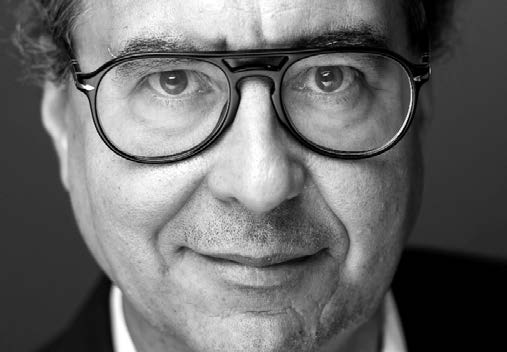
For over 20 years, DR. MARK WARE has been working on evaluating patient-driven questions concerning the safe and effective control of pain and its consequences.
From 2001 to 2018, while on the faculty at McGill, he was deeply involved in the development of pain education curricula and in the teaching of pain management to students, residents and health professionals.
One of his goals as the Director and Chair of the Alan Edwards Pain Management Unit is to support the ability to offer patients truly interdisciplinary pain management.
Tuesday, May 21, 7:30 PM, online
Dr. Dao Nguyen
Antimicrobial Resistance, the Silent Pandemic
Antimicrobial resistance (AMR) occurs when bacteria and other microbes causing illness become resistant to antimicrobial drugs, most notably antibiotics.
Once-treatable infections could become untreatable or require more toxic “last resort drugs”. AMR is recognized as one of the top threats to human health across the globe by the WHO, could threaten the lives of 10 million people worldwide every year and cost up to 100 trillion by 2050. Yet few people outside the public health communities have heard about it or understand what is at stake…
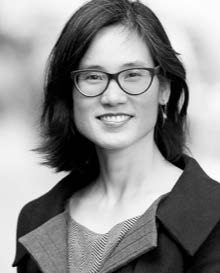
DR. DAO NGUYEN is an Associate Professor of Medicine at McGill University, a respirologist a the McGill University Health Centre, a clinician-scientist at the Research Institute of the McGill University Health Centre.
She is a Chercheur de Mérite of the Fonds de Recherche Québec – Santé and past recipient of career awards from the Canadian Institutes of Health, Burroughs Welcome Fund and Cystic Fibrosis Canada.
Dr. Nguyen’s research focuses on understanding the mechanisms of chronic bacterial infections, particularly those causing respiratory infections. She is also interested in new diagnostic and therapeutic innovations that can help address the rising threats of antimicrobial resistance.
Dr. Nguyen is the founding director of the McGill AntiMicrobial Resistance Centre whose purpose is to help advance research and build an interdisciplinary scientific community to fight against antimicrobial resistance.
 St. James Literary Society